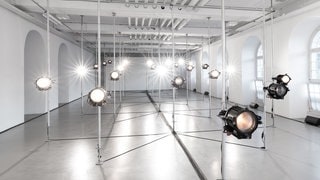
In each of three episodes, a historical eavesdroppping/warning system is presented. What they all have in common is their local ties: they are shaped by the architecture of their location, or conversely, have shaped an architecture which is optimized for their function. They are all out of service, yet open to the public and acoustically shaped by their visitors: tour groups squeezing through narrow corridors and playfully evoking warning signals; school classes whistling and clapping their way through large reverberant spaces. By microphoning and recording these places, the audio piece assumes not only the role of a sonic cartographer, but also that of a sociological observer: what can be heard is the peculiarity of the places, but also the reaction of those who visit them.
First episode: Orecchio di Dionisio
This limestone cave in the Sicilian city of Syracuse, built in ancient times, has exceptional acoustics: a word whispered deep inside the cave is understood at the cave entrance. The painter Michelangelo da Caravaggio reports that the tyrant Dionysios I had his political prisoners incarcerated here so that they could be overheard with the help of the cave acoustics.
Second Episode: Uguisubari
Uguisubari are sounding plank floors in Japanese temples and castles. In the Edo period, the nightingale floor (the literal translation) was a widely-used acoustic warning system: when stepped on, floorboard nails rubbed against metal clamps mounted on the underside of the floor. This produced a treacherously-squeaking sound similar to the chirping of the Japanese nightingale.
Third Episode: Sound Mirrors
Sound Mirrors are an early form of concave mirror microphones constructed on the coast of southern England in the 1920s. The brutalist- looking concrete structures are shaped like parabolic mirrors and are up to 70 meters wide. They were used for acoustic spotting of airships and aircraft. Due to the Covid lockdown, it was not possible to record directly on site – Youtube films were used as sound documents, in which the sound mirrors are walked on and/or explored with drones.
The jury gave the following reasons for their decisions
The Karl Sczuka Prize for Radio Drama as Radio Art 2022 goes to the radio play Überwachung – in drei Episoden by Jan Jelinek. In Überwachung, Jan Jelinek focuses his acoustic research on a historical interception or warning system: an ancient limestone cave in the Sicilian city of Syracuse, sounding floorboards in Japanese temples and castles, and acoustic concave mirrors in concrete buildings on the southern English coast.
In his composition, the author unfolds an atmospherically dense noise cosmos from the perspective of the people moving within it. The multi-layered texture of his audio piece unfolds a subtle groove that is fed both by the sonority of the spaces themselves and by the acoustic reactions of the visitors. The literal ambiguity of the theme of surveillance is reflected in the ambivalence of a seemingly perfectly arranged soundscape.
Karl Sczuka Prize awarded for the 61st time
This year, 109 competition entries from 31 countries were submitted. An independent jury chaired by visual artist Olaf Nicolai decided on the winners on Thursday, June 23, 2022, in Baden-Baden. Other jury members were Inke Arns, Julia Cloot, Michael Grote and Thomas Meinecke.
Jan Jelinek
deals in his work with the translation of popular music sources into abstract textures. No traditional musical instruments are used – rather, collages are constructed from tiny particles of sound.
Since 2000, he has published under his own name as well as under various pseudonyms (including Ursula Bogner). He has collaborated with Sven-Åke Johansson, Sarah Morris, Masayoshi Fujita and many others. In 2007 he founded the improv trio Groupshow with Hanno Leichtmann and Andrew Pekler.
Since 2012, he has been writing and producing experimental radio pieces for the SWR that explore fictional identities and soundscapes.